BlogAI
AI Brings Back the Waterfall, Hopefully in a Good Way
Spec-driven development brings back the waterfall. That is fine if agents prototype and measure before the spec. Real examples from my own agent sessions.
When I help teams introduce coding agents, I come across one process more and more often, mostly in large organizations. It starts with a specification, then comes a plan, then a task list, and at the end agents work through the tasks in a batch run. The name for this is spec-driven development, and its shape is that of the waterfall model.
On 18 November 2026 I gave a 45-minute talk about this at VibeKode Berlin, titled Stop the Waterfall: Why Spec-Driven Development Must Not Fall Back into Old Patterns. This article is the written version for people who were not there. The slides are on GitHub, also as a PDF.
The title of the talk sounds stricter than my position is. I have nothing against specs and nothing against batch runs. The trouble starts where a decision can no longer be reached by the feedback that would correct it. The first half of this article makes that argument. The second half shows what it looks like in my own work with coding agents, with five stories from a project that is public on GitHub.
What I see at larger customers
Spec-driven development, as the teams I meet practise it, runs in four steps. First the team specifies, then it plans, then it breaks the work into tasks, and at the end it implements. Each step hands a document down to the next one, and agents run in batch at the end. Drawn as four boxes, each a little lower than the one before, the process already looks like a waterfall.
Behind it sits a division of labour that sounds reasonable. Humans own the what, and agents own the how. The reasoning goes that humans know the customer, agents are good at code, and humans are too slow for coding anyway. So a document passes from the humans to the agents, in one direction only.
Followed to its end, this division of labour leads to the dark factory. The term comes from manufacturing, where a lights-out factory runs without people. In software it is now used for fully autonomous pipelines, where a spec goes in and software comes out.
The everyday version in enterprises is less dramatic, and I see it often. The agent sits behind the ticket system. Someone writes the spec into a GitHub issue or a Jira ticket and assigns it. The agent picks it up in the background, and what comes back is a pull request. Between the ticket and the pull request nobody watches the agent work, and the agent has nobody to talk to. For a small task with a clear outcome that is a good way to work. It becomes a problem when the ticket still contains open decisions, because the agent then makes them where nobody sees them.
The belief underneath is that we only have to specify thoroughly enough. More effort up front is supposed to remove the need for feedback later. “Write the perfect AGENTS.md”, the file with the standing instructions for an agent, is the newest form of that sentence.
I understand why large organizations like this model. It fits the roles and the governance they already have. It also puts the agent in the place the offshore team used to have. You write the spec, throw it over the wall, wait, and are surprised by what comes back. My criticism is aimed at the handoff. It says nothing about the people on the other side of it.
All of this is what I see at my own customers, mostly larger ones. I have no industry statistic for it.
What has to happen before the spec
At one customer with a batch pipeline for agents I said out loud in a meeting that this is waterfall. Then I learned how their specs come about. Before anyone writes a spec, the team works out interactively what should be built. The spec records what came out of that. That made me revise my verdict.
My name for this work before the spec is discovery. By that I mean that agents are already at work while the spec takes shape, on experiments, prototypes, click dummies, feasibility studies and optimizations. The code that comes out of this is not shipped. In this phase a prototype is a measuring instrument.
I tell my customers that AI finally brings real software engineering. Suppose a spec is going to contain the sentence “We need CQRS”. CQRS is an architecture pattern that splits reading and writing data into separate models, which makes a system more complex. My proposal is then to build one prototype with CQRS and one without. We have an agent build a load generator, measure how both variants scale and compute metrics for the size and complexity of the code. Only then do we decide. That used to be too much effort for a single architecture decision. With agents it is affordable.
In the end the spec may contain only that one sentence, but there is a lot of groundwork behind it. I can live with a spec like that. The sentence was not written down lightly, because whoever put it there knows its consequences.
That is why the origin of a spec counts for more than its length or its format. A spec made of guesses is dangerous, a spec made of discoveries is valuable. When an agent reads a spec, it cannot tell which sentence somebody verified and which one was only an assumption or a guess. To the agent a guess in a spec looks like a fact. It implements “We need CQRS” just as faithfully when nobody has measured anything. A generated spec adds to the problem, because it always looks polished. Polish signals confidence, but it is not evidence.
So I had to say more precisely what I mean by waterfall. A long spec does not make a process waterfall. Neither does a batch run, and neither do steps in a fixed sequence.
A process is waterfall when its decisions are cut off from the feedback that could correct them.
Measured by that definition, my verdict in the meeting was half right. The customer’s decisions about what to build do get feedback, because the discovery happens before the spec. The decisions the agent makes during the batch run do not, because nobody looks in until it is done.
One of our own projects shows on a small scale what it looks like when feedback does reach the specification. Before we changed a Jira import, we agreed the test cases with the customer, and a run against a copy of production then showed what the mocks had hidden. The details are in Testing a Jira Integration When There Is Only a Live Jira.
We have been here before
In 1970 Winston Royce published “Managing the Development of Large Software Systems”, the paper that everyone cites for the waterfall model. Royce never used the word “waterfall”. About the single pass through the steps he wrote: “I believe in this concept, but the implementation described above is risky and invites failure.” His remedy was “Do it twice”, which meant building a pilot version first.
In 1975 Fred Brooks wrote in The Mythical Man-Month: “Plan to throw one away; you will, anyhow.” His 1986 essay “No Silver Bullet” contains the sentence “The hardest single part of building a software system is deciding precisely what to build.” The same essay advises us to “grow, not build, software”. In the anniversary edition of his book in 1995, Brooks called his own advice from 1975 wrong, because it assumes the waterfall model, and argued for incremental growth.
Spec-driven development today sits between 1970 and 1975. The dark factory is the single pass that Royce called risky. The customer from the previous section does it twice, with one interactive pass to discover and one batch pass to build. That is the “good way” in the title.
If AI brings the waterfall back, I hope it comes back the way Royce described it, with a pilot version first.
Brooks needed twenty years to get from “plan to throw one away” to incremental growth. Both texts are on the shelf today, so the same detour should not take us that long.
What is cheap and what is scarce
In “No Silver Bullet” Brooks separated the essence of software work, deciding what to build, from the accident, writing it down. Agents attack the accident.
Code is cheap to write and still expensive to own.
Owning code means reading, running, changing and explaining it, and that cost has not dropped. What is scarce is evidence that something works, and people who understand why. My conclusion is to spend the cheap thing in order to get the scarce ones.
For that, knowledge has to flow in both directions, and in both phases of the work:
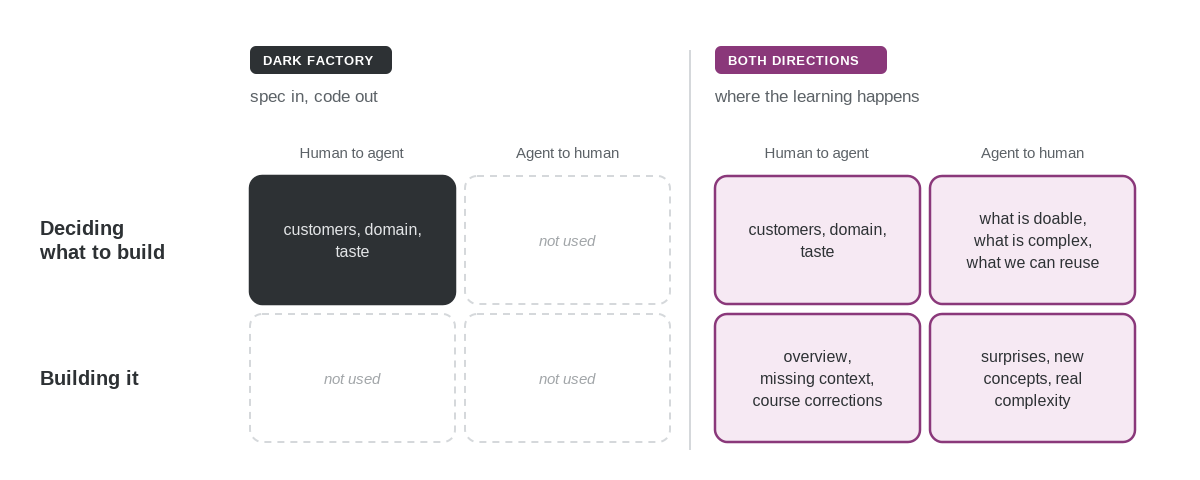
The upper left cell is the division of labour from the beginning of this article. For the upper right cell we have a documented example. In our UI redesign with Claude Code and impeccable the loop was critique, three variants, pick, polish. The agent’s critique and its variants came first, and our decision came after them. The dark factory uses only the upper left cell, and the other three are where the learning would have happened.
The dark factory erodes the expertise it depends on.
Good specs need understanding, and understanding comes from being involved. The better the factory runs, the less people touch the work, and the weaker their next spec will be.
We tried spending the cheap thing on our own product. With sidekick, a new and exploratory module of our time tracking product time cockpit, we want to find out how you bill time when people mostly manage agents. We vibe coded it as a throwaway prototype, with no spec on purpose, and shipped it to customers labelled as a preview. Stop Being Afraid of the Prototype tells that story. I would put one thing differently today. That post says that we “rebuild the version we keep on a solid foundation”. After reading Brooks again I would rather grow it. That means hardening what has settled and exploring the rest further, with a gate for each hypothesis instead of one for the whole product.
How I put this into practice in my own work
Up to here this article has been an argument, and most of it was about other people’s pipelines. Criticizing someone else’s process is easy. So the rest of the article is about my own work. The stories are examples of what I mean by everything said so far, and of how I put my own recommendations into practice. It is one way of working and certainly not the only one. I write specs with agents too, and I let agents run for an hour at a time. What I watch for is whether feedback can still reach the decisions.
The five stories below come from one project. Each of them picks up a point from the first half. They are about where a spec comes from, what the agent can tell me while I decide what to build, how I stay in touch with a running agent, what happens to designs that are never built, and when I slow down on purpose.
The project is called Novedu, and it needs a short introduction. Besides my role as CEO of software architects I am a part-time teacher at HTL Leonding and FH Hagenberg, and mentor and chairman of Coding Club Linz, which runs volunteer-driven activities for children and teenagers such as CoderDojo Linz. AI in computer science teaching is the topic that keeps me awake at night. That is why I put so much time and effort into Novedu.
On Novedu, teachers set up AI-supported exercises for their classes, for example a tutor to chat with, a quiz whose answers an AI grades, or a writing exercise with AI feedback. The code, the pull requests and the technical docs are public on GitHub, and the teacher guide shows what the platform does. All five stories are real and come from the last few months of work on it.
A prototype before the spec
Moodle is the learning platform that many schools and universities use for course material, assignments and grades. My colleagues wanted the result of a Novedu quiz to arrive in the Moodle gradebook, so that they would not have to copy grades by hand.
I did not know Moodle, so I let the agent teach me first. It researched, and I asked beginner questions, one of which ended with “I am a Moodle noob.” Then, before any spec existed, I asked for a small feasibility study:
That sounds great. What could be a minimal feasibility study to verify the technical details how we can integrate Novedu and Moodle? Do not just rely on docs. Prove it using a mini prototype. The goal is not yet to build the integration. […]
The agent set up a real Moodle to test against and built a small tool that talks to it. That prototype corrected assumptions on points where the documentation was ambiguous. For example, a teacher at my school cannot connect an external tool such as Novedu to Moodle on their own. An administrator has to do that.
The product decisions came after the prototype, in a long round of questions and answers with the agent, and only then was the design written. The first implementation plan split the work into nine pull requests. I answered with “I would like to challenge the large number of PRs. Why is that necessary?” and the agent replied “The nine PRs were my choice, not something the work needs”.
The prototype code never shipped. The plan for the real feature mentions it only as a reference for how the two systems talk to each other, not as code to build on. The feature itself is merged and documented.
Throw away the prototype’s code and keep what it taught you.
I take two things from this story. When a spec would have to rest on documentation alone, let the agent prove the idea against the real system first. And when a plan looks large, ask whether the size comes from the work or from the agent’s choices.
Questioning requirements
Code that I do not write is code that I do not have to own. So I often ask the agent which requirements make a design expensive. In the Moodle story I did that when the design was written and nothing was built yet:
Review the spec from one angle: Are there small changes to requirements that would significantly simplify the design/code?
The agent came back with four candidates, ordered by how much each one would save. For each it listed what would disappear from the code and what that would cost the people who use Novedu. I took two of the four, and not the same two the agent recommended. How much convenience for teachers is worth how much code is my decision. My next message was “Do we really need to store Moodle names? Do we need to store handed-in scores?” The agent’s answer was no to both, because each of them only fed one line of text on the screen. I dropped them as well, and Novedu now keeps less personal data.
Ask the agent which requirements make the code complex. What each one is worth is your decision.
This is the upper right cell of the knowledge-flow diagram. While I decide what to build, the agent tells me what is complex. The question works on any spec, as long as you ask it before the code exists.
Steering a running agent
The Moodle story ends here. The next example comes from a different part of Novedu. There I wanted an AI tutor that can draw on a board next to the chat while it explains, the way a teacher draws on a blackboard.
Nothing was specified at the start. I had the agent explore how a model can produce drawings that are good enough to teach with. It got a goal but no list of steps. The stop condition read “Stop when you see that changes do not lead to significant improvements anymore.” In the talk I called this a hill climb instead of a staircase. The earlier post has it under Lead by goals, not by tactics.
Later the agent was building a clickable mockup and had spent eight minutes debugging one detail, a highlight overlay. I wrote to it while it was working and offered a simpler solution:
Do you have problems with the highlighting? A simpler, acceptable version would be to just change properties of the shapes (e.g. font color, fill color, stroke thickness change). Would that help? Simple, straightforward solutions are important.
Right after my message the agent stopped what it was doing and changed its approach. A few minutes later the mockup was finished.
The implementation then ran for almost an hour. During that run I sent a checklist of things not to forget and asked for one extra deliverable. The agent took both in and kept going without a restart. Every item of the checklist is in the result. It is merged (#240, #241) and documented.
Batch is fine as long as it is not dark.
For me that takes a window into the running agent, a way to steer it without a restart, runs that take hours and not weeks, and a retrospective afterwards. This session had the first three.
By a window I mean that I can look in at any time. That does not mean I have to sit next to the agent and watch. I have four monitors around me and mostly see my agents out of the corner of my eye. A quick glance is often enough to notice that an agent is not making progress or is going in circles. With an agent behind a ticket there is no such window. I see the ticket and, much later, the pull request.
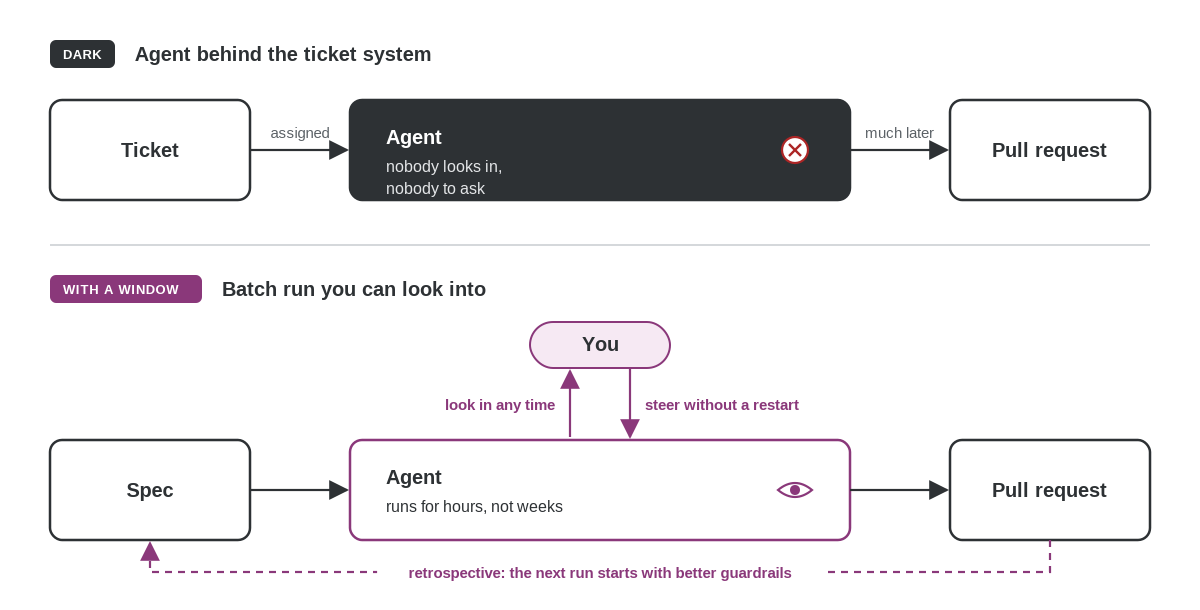
I also plan my tasks around this. I deliberately run well-prepared, well-researched tasks at night or while I am away. I start more experimental tasks when I am near the agent, and by near I mean digitally near. I really value that my tools can be controlled remotely, because that lets me give an agent feedback and steer it even when I am not at my desk.
If your tooling lets you write to an agent while it works, try it the next time a run seems stuck. Ask what the problem is, and offer a simpler requirement.
Three designs, none of them built
Novedu signs people in with their school accounts. Outsiders I want to win over to the platform cannot get in that way. In August I looked for a way to let them try it and asked the agent for invite codes. It asked a few questions and wrote a design.
The same afternoon I questioned the whole approach:
I want to question the design decision: What if we forget all that complicated auth stuff and use Auth0 […]? If you were in my shoes, which road would you take?
The agent evaluated a hosted identity service and the alternatives, and I pushed further on what it would cost for several schools. Less than two hours later my message was “You convinced me to drop the Auth0 approach.”
The invite codes were never built. Two more designs followed in September and October, and neither was built as written. What shipped in October was something simpler, a demo login and a setup for trying Novedu on your own machine (#197, #198).
I would rather throw away three designs than own code I do not need.
I do not regret these conversations, because they led me to the simpler solution. The question at the end of my prompt works in any project. Ask the agent which road it would take in your place, and let it argue against your idea.
Two evenings without code
The last story is about a playful extra for students that I will not spoil here. I had a few ideas for it and told the agent not to take them literally:
I have no idea how to implement them, they are not thought through. They are just a vision. Do not take them literally. Try to understand the gist of it.
Over two evenings in November, ideas were added and dropped. Then the agent began to answer each idea with its technical consequences, and I stopped that with “You switched way too fast to implementation mode.” Right afterwards, and without being asked, the agent wrote a note for future sessions into its own memory, saying in effect that a brainstorm works on the concept before the implementation. That is a small case of what I asked for in the talk. Guardrails grow with every run, and every retrospective changes a doc, a test or a tool.
Then I asked for a working document that records what we agreed on and what we dismissed. Its status line reads “brainstorm in progress. […] Nothing here is approved for implementation.”
Two evenings without code are slow on purpose. I do not have to keep up with the agent. If an agent starts to implement while you are still thinking, tell it, and ask for a document that separates what is decided from what is only proposed.
The agent needs feedback too
The definition of waterfall from earlier applies to more than my decisions. The agent makes decisions all the time while it works, and it needs feedback for them as well. Whether it gets that feedback is up to me. In the talk I called this AI empathy. I put myself in the agent’s position and ask three questions.
- What can it see? In the Moodle story it had a real Moodle, where it could try out what the documentation left open. It also has a browser to look at what it has built.
- What can it check? It can run the tests. All of them have to be green before anything is published.
- Whom can it ask? Me. It asks me questions before it writes a design, and my messages reach it while it works.
An agent that sits behind the ticket system has nobody to ask. A better model does not change that, because even the best model can only see, check and ask what somebody makes available to it.
Takeaway
I have nothing against specs, phases and batch runs. So my verdict on spec-driven development is to keep the specs and change where they come from. Behind a sentence like “We need CQRS” I want prototypes and measurements, not a guess. And when the agents build, I want to be able to look in and steer.
The waterfall is welcome back if we try things out and measure before the spec, and if somebody can look in while the agents build.
That is what I mean by the good way in the title. To me it is the software engineering that AI finally makes possible.
I ended the talk with four questions to take to work on Monday:
- Did your spec come from guesses or from discoveries?
- Can you look into a running agent and steer it?
- What did the last run teach the next one?
- What did you learn this week?
The last one matters most to me, because your own understanding is the scarce resource.
If your team wants to work with coding agents this way in its own code base, let’s talk about harness engineering for your project.
